Oct 24, 2026Water-bottle-cap-guide
Plastic Fragments in 5-Gallon Water: Where Cap Fragments Come From — and How the Tri-Pierce Cap Removes the Source
Plastic Fragments in 5-Gallon Water: Where Cap Fragments Come From — and How the Tri-Pierce Cap Removes the Source
A customer mounts a 5-gallon jug on the dispenser, fills a cup, and finds a small piece of plastic at the bottom. The question is where it came from — and what you can honestly tell them.
Scope: reusable 5-gallon systems
These jugs are refilled dozens of times, handled by route drivers, stacked in warehouses, and mounted upside down on a dispenser probe. The 55mm cap must seal a reused, blow-molded neck and survive multi-trip handling. Fragment problems here are a reusable-packaging problem, with specific sources.
Separate two things
Visible foreign matter — millimetres across, visible, pickable. This is not a toxicology question. It is a foreign-matter defect: a quality and food-safety compliance failure, and a physical hazard — a hard plastic piece is a choking risk for a child and an injury risk if swallowed. No lab report is needed to call it a defect.
Micro- and nanoplastics — here precision matters. WHO's 2019 report Microplastics in drinking-water concluded that microplastics "don't appear to pose a health risk at current levels," while stressing that more research is urgently needed. Particles above roughly 150 micrometres are unlikely to be absorbed; data on smaller and nano-sized particles is, in WHO's words, "extremely limited." The 2022 WHO report on nano- and microplastics in food, water and air reached the same conclusion shape: no established health risk at typical exposure, major uncertainties remaining.
A cap supplier therefore cannot claim to protect health. What a well-designed cap can do is remove a contamination source before it enters the jug — a quality and liability argument, verifiable and testable.
Where cap fragments come from
Three of the four main sources are decided at the design stage:
- The inner plug. Conventional caps carry a separate centre plug. The dispenser probe pushes against it; if it is not fully seated, off-centre, or poorly retained, the probe can push it into the water.
- Centre tear-out. Designs that require the centre to be pierced or removed can leave a fragment attached or detached.
- Moulding flash. Worn tooling leaves thin fins on the sealing edge or inside the skirt that break off later.
- Handling damage. Deformed caps can crack or shed material — the only one of the four that is a packing issue.
This is why better cartons never fix a fragment complaint.
Rule out the other sources first
Fragments in a 5-gallon system can also come from the jug (reused polycarbonate scratches and spalls), the dispenser probe or reservoir, or the bottle washer. Before blaming the cap, check three things:
- Does the fragment match the cap's material and colour?
- Is any part of the cap missing, or is the centre deformed?
- Does it appear only with certain dispensers or jug batches?
A supplier who cannot help you run these checks is guessing.
What the tri-pierce cap changes
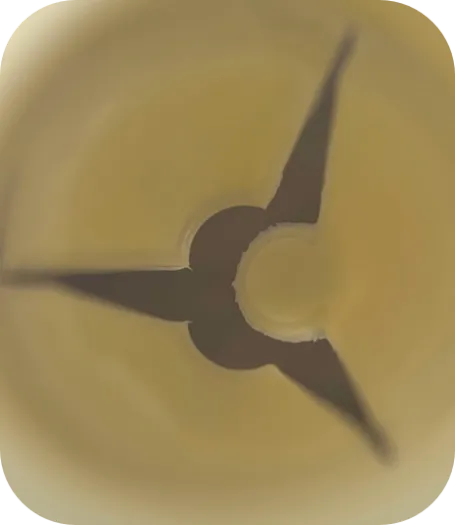
The tri-pierce cap uses a three-point structure integrated into the cap instead of a separate loose plug. Two consequences follow from the structure itself:
- No independent plug for the dispenser probe to push into the water.
- No tear-off fragment left behind when the cap is opened or mounted.
In tracked customer use, the design has cut related complaints by 90% — fewer replacement jugs, fewer complaint calls, and a defensible answer when a customer asks what was in the water.
Stated plainly: this describes the cap's structure. It is not a guarantee against every foreign object. The jug, washer and dispenser remain separate sources; treating the cap as one controlled source is what makes the claim credible.
Verify before switching
- Sample batch in 3 days.
- Open 20-30 caps at different angles; inspect the opening edge and cap interior.
- Mount two or three on your own filled jugs, invert on a dispenser, check the water.
- Repeat with a second batch for consistency.
Bulk production runs 15-25 days after order confirmation.

